Elevate Your Space: Infusing Spiritual Serenity with Mandala Designs
In today's fast-paced world, creating a sanctuary within your home has become more important than ever. The spaces we inhabit directly influence our mental well-being, emotional balance, and spiritual growth. One of the most effective ways to transform your environment into a haven of tranquility is through the incorporation of mandala designs. These ancient, sacred geometric patterns have been used for centuries across various cultures to promote healing, meditation, and spiritual awakening. At KieranGrant, we believe that your home should be a reflection of your inner peace and spiritual aspirations. This comprehensive guide will explore how you can elevate your space by infusing it with the profound beauty and spiritual serenity that mandala designs offer.
Understanding the Essence of Mandalas
The Historical and Cultural Significance of Mandalas
Mandalas are far more than decorative elements; they are spiritual tools with deep roots in multiple cultures and traditions. The word mandala comes from Sanskrit, meaning circle or disk, and these intricate patterns have been integral to Hindu, Buddhist, and Islamic art for thousands of years. In Hinduism, mandalas represent the universe and the cosmos, serving as a visual representation of the connection between the inner self and the outer world. Buddhist mandalas, particularly those created in Tibetan traditions, are used as meditation aids and are believed to facilitate spiritual transformation and enlightenment.
The creation of mandalas is itself a spiritual practice. Monks and artists spend countless hours crafting these intricate designs, viewing the process as a form of meditation and devotion. Each element within a mandala carries symbolic meaning, from the center point representing the divine source to the outer layers symbolizing the material world. Understanding this rich history helps us appreciate mandalas not merely as beautiful patterns but as powerful spiritual instruments.
The Psychological Impact of Mandala Patterns
Beyond their spiritual significance, mandalas have a profound psychological impact on those who view and interact with them. The symmetrical, circular nature of mandalas naturally draws the eye inward, promoting a meditative state of mind. Research in color psychology and visual perception has shown that gazing upon mandala patterns can reduce stress, lower blood pressure, and promote a sense of calm and centeredness. The repetitive geometric patterns engage the brain in a way that quiets mental chatter and encourages mindfulness.
When you incorporate mandalas into your living space, you're essentially creating visual anchors for meditation and contemplation. The brain responds positively to symmetry and order, and mandalas provide both in abundance. This is why many people find themselves naturally drawn to these patterns and why they have become increasingly popular in modern wellness and interior design practices.
The Spiritual Benefits of Mandala Integration
Creating a Sacred Space for Meditation and Reflection
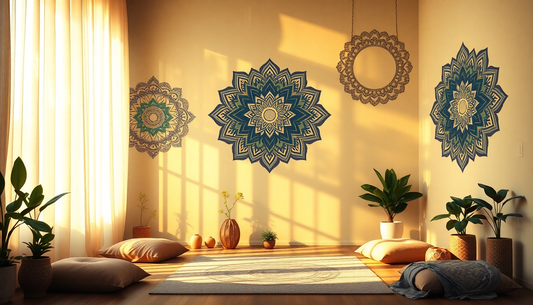
One of the primary benefits of incorporating mandalas into your home is the creation of a dedicated sacred space for spiritual practice. Whether you have an entire room or just a corner, mandala designs can help define and consecrate this area as a place of spiritual significance. When you establish a meditation space adorned with mandalas, you're signaling to your mind and spirit that this is a place set apart from the mundane concerns of daily life.
The presence of mandalas in your meditation space serves multiple functions. They provide a focal point for your gaze during meditation, helping to anchor your attention and prevent the mind from wandering. They also serve as a visual reminder of your spiritual intentions and commitments. Each time you enter this space, the mandalas reinforce your dedication to inner peace and spiritual growth.
Enhancing Energy Flow and Chakra Alignment
In many spiritual traditions, mandalas are associated with the chakra system, the network of energy centers believed to run through the human body. Different mandalas correspond to different chakras, each with its own color, frequency, and spiritual significance. By strategically placing mandalas throughout your home, you can create an environment that supports the harmonious flow of energy and promotes chakra alignment.
For instance, red and orange mandalas are associated with the root chakra, promoting grounding and stability. Yellow mandalas correspond to the solar plexus chakra, enhancing personal power and confidence. Green mandalas relate to the heart chakra, fostering love and compassion. Blue mandalas support the throat chakra, facilitating clear communication. Indigo mandalas are connected to the third eye chakra, enhancing intuition and spiritual insight. Finally, violet mandalas relate to the crown chakra, promoting spiritual connection and enlightenment.
By understanding these associations, you can select mandalas that address specific areas of your life that need attention or enhancement. This intentional approach to mandala placement transforms your home into a holistic wellness environment that supports your spiritual development on multiple levels.
Promoting Mindfulness and Present-Moment Awareness
In our increasingly distracted world, cultivating mindfulness and present-moment awareness is essential for mental health and spiritual growth. Mandalas serve as powerful tools for developing these capacities. The intricate details and symmetrical patterns of mandalas naturally encourage a state of focused attention. When you take time to truly observe a mandala, noticing the interplay of colors, the precision of the geometric forms, and the overall harmony of the design, you are practicing mindfulness.
This practice of mindful observation can be extended throughout your day. As you move through your home and encounter mandalas in various spaces, each encounter becomes an opportunity to pause, breathe, and reconnect with the present moment. Over time, this repeated practice strengthens your ability to maintain mindfulness in all aspects of your life, not just when you're actively meditating.
Selecting the Right Mandalas for Your Space
Understanding Different Mandala Styles and Designs
The world of mandala design is incredibly diverse, ranging from traditional religious mandalas to contemporary artistic interpretations. When selecting mandalas for your space, it's important to understand the different styles available and how they might resonate with your personal aesthetic and spiritual preferences.
Traditional mandalas, such as those found in Hindu temples or Tibetan Buddhist monasteries, often feature intricate geometric patterns with deep spiritual symbolism. These designs are typically highly symmetrical and may include Sanskrit or Tibetan script. Contemporary mandalas, on the other hand, often blend traditional elements with modern artistic sensibilities, incorporating new color palettes and design innovations while maintaining the essential spiritual qualities of the form.
Floral mandalas incorporate botanical elements, creating designs that feel organic and natural while maintaining the geometric precision of traditional forms. Geometric mandalas emphasize mathematical patterns and symmetry, appealing to those who appreciate the intersection of spirituality and science. Celestial mandalas feature stars, moons, and cosmic imagery, connecting the viewer to the vastness of the universe. Animal mandalas incorporate creatures and wildlife, bringing the energy of nature into your space.
Choosing Colors That Resonate with Your Intentions
Color plays a crucial role in the spiritual and psychological impact of mandalas. Each color carries its own vibration and meaning, and selecting mandalas in colors that align with your intentions can significantly enhance their effectiveness in your space.
Red and deep orange mandalas are energizing and grounding, ideal for spaces where you want to cultivate strength, courage, and vitality. These colors are associated with passion, action, and physical vitality. Yellow and gold mandalas promote joy, optimism, and mental clarity, making them excellent choices for home offices or creative spaces. Green mandalas foster healing, growth, and renewal, perfect for bedrooms or spaces dedicated to rest and recovery. Blue mandalas encourage calm, communication, and spiritual awareness, ideal for meditation rooms or spaces where you want to promote peace and tranquility.
Purple and violet mandalas connect you to higher consciousness and spiritual wisdom, making them excellent for spaces dedicated to spiritual practice or personal transformation. Pink mandalas promote love, compassion, and emotional healing, perfect for creating nurturing family spaces. White and silver mandalas represent purity, clarity, and new beginnings, ideal for spaces where you want to cultivate fresh starts and spiritual clarity. Black mandalas, often combined with other colors, provide grounding and protection, useful in spaces where you want to establish strong energetic boundaries.
Size and Placement Considerations
The size and placement of your mandalas significantly impact their effectiveness in transforming your space. Large mandalas, such as wall tapestries or floor rugs, create a dominant focal point and can completely transform the energy of a room. These are ideal for meditation spaces, bedrooms, or living areas where you want to make a bold spiritual statement. Medium-sized mandalas, such as framed prints or smaller tapestries, work well in hallways, bathrooms, or office spaces where you want to introduce spiritual elements without overwhelming the space.
Small mandalas, such as decorative objects, throw pillows, or small framed prints, can be placed throughout your home to create a cohesive spiritual environment. These smaller pieces work well in clusters or as accents that tie together the overall design of a room. When placing mandalas, consider the natural flow of energy in your space. In feng shui tradition, the center of a room or home is considered the most powerful position, making it an ideal location for a significant mandala. Corners and alcoves can also be powerful placement locations, as they naturally draw the eye and create intimate spiritual spaces.
Incorporating Mandalas into Different Rooms
The Bedroom: Creating a Sanctuary for Rest and Renewal
Your bedroom should be a sanctuary dedicated to rest, rejuvenation, and intimate connection. Incorporating mandalas into this space can significantly enhance its spiritual and restorative qualities. A large mandala tapestry hung above the bed creates a powerful focal point and can serve as a visual anchor for meditation or contemplation before sleep. The symmetry and balance of the mandala design promote a sense of harmony and peace that facilitates deep, restorative sleep.
Consider selecting mandalas in soft, calming colors such as blues, greens, purples, or pastels. These colors naturally promote relaxation and are less stimulating than bright, warm tones. You might also incorporate mandala-patterned bedding, throw pillows, or a mandala rug to create a cohesive, spiritually aligned bedroom environment. Some people find that gazing upon a mandala before sleep helps quiet racing thoughts and promotes a meditative state conducive to restful slumber.
The Living Room: Fostering Connection and Harmony
The living room is often the heart of the home, a space where family members gather and guests are welcomed. Incorporating mandalas into this space can foster a sense of harmony, connection, and spiritual awareness among all who enter. A large mandala artwork or tapestry can serve as a conversation piece and a visual representation of your spiritual values and aesthetic preferences.
Consider placing a mandala in a prominent location where it naturally draws the eye, such as above a fireplace, on a feature wall, or in a central location. You might also incorporate smaller mandalas as decorative accents, such as throw pillows, table runners, or decorative objects placed on shelves or side tables. The key is to create a balanced, intentional arrangement that feels harmonious rather than cluttered. A well-designed living room with mandala elements creates an environment where people naturally feel more relaxed, present, and connected to one another.
The Home Office: Enhancing Focus and Creative Energy
If you work from home or maintain a home office, incorporating mandalas can significantly enhance your productivity, focus, and creative energy. The meditative qualities of mandala designs help quiet mental chatter and promote a state of focused concentration ideal for work. A mandala placed on your desk or on the wall in your direct line of sight can serve as a visual anchor that helps you maintain focus and intention throughout your workday.
Consider selecting mandalas in colors that promote mental clarity and creative energy, such as yellow, orange, or green. You might also choose mandalas with geometric or celestial themes, as these designs often appeal to the analytical mind and can enhance problem-solving abilities. Some people find that taking brief mandala meditation breaks throughout the day helps reset their mental state and return to their work with renewed focus and creativity.
The Bathroom: Creating a Spa-Like Retreat
The bathroom is often overlooked as a space for spiritual practice, yet it offers unique opportunities for incorporating mindfulness and self-care rituals. A mandala-themed shower curtain, bath mat, or wall art can transform your bathroom into a spa-like retreat dedicated to self-care and renewal. The bathroom is an ideal space for incorporating water-themed mandalas or mandalas in blues and teals, colors that naturally evoke the calming qualities of water.
Consider creating a small altar or meditation space in your bathroom where you can place a mandala image, candles, and other spiritual objects. This transforms your daily bathing routine into a sacred ritual of self-care and spiritual renewal. Many people find that incorporating mandalas into their bathroom creates a space where they can pause, breathe, and reconnect with themselves during their busy day.
The Kitchen: Infusing Daily Rituals with Spiritual Awareness
The kitchen is the nourishment center of the home, a space where we prepare food and sustenance for ourselves and our loved ones. Incorporating mandalas into this space can help infuse your daily cooking and eating rituals with spiritual awareness and intention. A mandala-themed kitchen towel, wall art, or decorative tile can serve as a visual reminder to approach food preparation with mindfulness and gratitude.
Consider selecting mandalas in warm, nourishing colors such as oranges, yellows, or reds. You might also choose mandalas with botanical or floral themes, connecting the food you prepare to the natural world from which it comes. Some people find that placing a mandala in the kitchen helps them approach cooking as a form of meditation and service, transforming everyday meal preparation into a spiritual practice.
The Entryway: Setting the Spiritual Tone for Your Home
Your entryway is the first space visitors encounter when entering your home, and it sets the energetic tone for the entire space. A mandala placed in your entryway serves as a powerful welcome and immediately communicates your spiritual values and aesthetic sensibilities. A mandala in your entryway also serves a protective function, creating a threshold between the outside world and your sacred home space.
Consider selecting a mandala that resonates with the energy you want to cultivate in your home. A mandala in warm, welcoming colors creates an inviting atmosphere, while a mandala in cool, calming colors promotes peace and tranquility. You might also incorporate a mandala doormat or wall hanging that greets visitors and sets the spiritual tone for their experience in your home.
Mandala Design Elements and Their Meanings
The Significance of the Center Point
At the heart of every mandala lies a center point, often called the bindu in Sanskrit. This central point represents the source of all creation, the divine spark, and the core of your being. In meditation practice, focusing on the center point of a mandala helps draw your awareness inward, away from external distractions and toward your inner spiritual essence. The center point serves as an anchor for your consciousness, a place of stillness and unity from which all other elements of the mandala radiate outward.
Understanding the significance of the center point can deepen your appreciation of mandalas and enhance their effectiveness as spiritual tools. When you gaze upon a mandala, allow your eyes to naturally settle on the center point. Feel yourself drawn inward, toward the source of peace and wisdom that resides within you. This simple practice of centering can be performed throughout your day, using the mandalas in your space as visual reminders to return to your center.
Geometric Patterns and Their Spiritual Meaning
Mandalas are built upon geometric patterns, each with its own spiritual significance. Circles represent wholeness, unity, and the eternal cycle of life. Squares represent stability, grounding, and the material world. Triangles point upward toward the divine or downward toward the material realm, representing the balance between spiritual and physical existence. Hexagons represent harmony and balance, while pentagons represent the five elements and human consciousness.
The specific arrangement and combination of these geometric forms creates the unique spiritual signature of each mandala. A mandala featuring predominantly circular patterns promotes a sense of unity and wholeness, while one featuring more angular, geometric forms may enhance mental clarity and analytical thinking. By understanding the geometric elements within your chosen mandalas, you can select designs that specifically support your spiritual intentions and personal growth.
The Symbolism of Petals and Layers
Many mandalas feature petal-like or layered designs that radiate outward from the center. These petals often represent different aspects of consciousness, different chakras, or different dimensions of spiritual reality. A mandala with eight petals, for instance, often represents the eight-fold path in Buddhism or the eight directions in many indigenous traditions. A mandala with twelve petals may represent the twelve months, the zodiac, or the twelve aspects of the divine.
The layered structure of mandalas also carries significance. Each layer represents a different level of consciousness or a different plane of existence. As you move from the center outward, you move from the most subtle, spiritual dimensions toward the more dense, material dimensions. This layered structure serves as a visual representation of the multidimensional nature of reality and consciousness, reminding us that we exist simultaneously on multiple levels of being.
Practical Ways to Incorporate Mandalas into Your Decor
Wall Art and Tapestries
One of the most popular and effective ways to incorporate mandalas into your space is through wall art and tapestries. Large mandala tapestries can completely transform a room, creating a focal point that draws the eye and sets the spiritual tone for the entire space. Tapestries offer flexibility in placement and can be easily changed or rotated as your spiritual practice evolves.
When selecting a mandala tapestry, consider the size of your wall and